
Dangerous Entertainment: From Georgian Rope Dancing to Modern Magic
Walking the streets of London in the early modern period (around the 1700s), it would be difficult not to encounter the cacophony of sounds, smells, and crowds of people of every shape, gender, and social class.
Nowhere was this more intensified than at the great fairs — Bartholomew Fair and Southwark Fair chief among them. Originally used for trade, many of these fairs eventually dedicated themselves to pleasure through the myriad entertainments on offer.
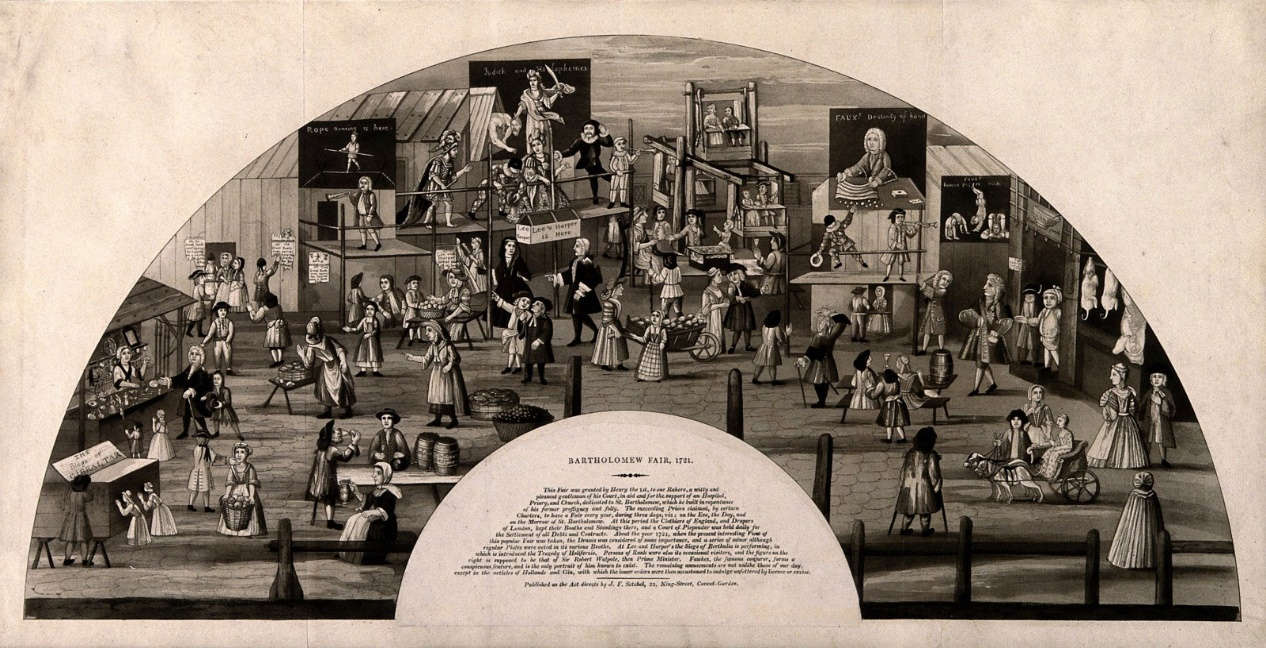
I know it’s hard for the modern mind to grasp, but close your eyes and imagine this: The air stinks of animals and ale, the perfect atmosphere for dangerous entertainment. The noise is overwhelming – people hawking their wares, the sizzle and smell of food, musky whiff of animals and sweat, the shouts of people booing performers or cheering actors on makeshift stages everywhere. – It’s absolute mayhem!
Then you gaze upward… and you see something extraordinary.
A single rope stretched above the crowd, with a performer calmly climbing, swinging and balancing as if falling isn’t an option. People crane their necks, half-terrified, half-delighted, unable to look away.
That intriguing mix of fear and fascination that hasn’t changed in hundreds, if not thousands, of years: modern audiences, watching a magician cut a spectator in half, still have the same reactions; human psychology hasn’t changed much in three hundred years! As one contemporary author wrote in 1729, it gives the viewer a certain “painful pleasure”[1] in viewing.
Rope Dancing – Dancing with Death
Rope dancing, to put it simply, is a performance upon a rope, from tightrope walking, slacklining, and even skipping, and dates back to the ancient Greeks.
This wasn’t just your average person walking across a tightrope as you’d see in the circus today.
Looking at contemporary playbills, you can see a range of rope-dancing styles, including the so-called flying-man act on an angled rope, where the skill was climbing and then descending by sliding downwards. Another style was the slack rope, shown with performers swinging whilst performing their feats—the image showing performers hanging from their feet. One playbill emphasises the danger, with a performer walking the slack rope suspended over swords.
Some routines went even further into the extreme, with dancers balancing children on their arms, hanging from their feet, or, quite spectacularly, fireworks “playing from different parts of their bodies[2]“. That would make Britain’s Got Talent gold!
Big Star Names
One of the first major rope dancers and possible celebrities was Jacob Hall, who became popular in the second half of the seventeenth century. Samuel Pepys commented in his diary about watching his act, and an advertised book published in 1792—long after his death—contained portraits, including one of “Jacob Hall, the Rope Dancer,[3]” showing his continued popularity to a generation who never saw his performance. The public regarded Jacob Hall in his prime, much as many of us idolise celebrities nowadays. His body “charm’d in Publick”, with ladies wanting to know “what he was in private,” regarding him “as a due composition of Hercules and Adonis[4].” One can see a link to magicians, as of writing this, a newspaper article suggesting that “Magicians are sexy now!”[5]!

The Allure of Danger
One aspect of rope dancing that audiences, past and present, notice is the inherent danger, with one false step leading to injury or, in the worst case, death. But one question stands out — why do people like to watch death-defying spectacles?
Sources show that people sought out danger and enjoyed it. Martin Burton, the founder of Zippo’s circus in the 1980s, suggests that “people definitely don’t want to see an accident, but people also want to feel they might see an accident[6]“—and it seems that this was the same in the seventeenth and eighteenth centuries.
An anonymous poem from 1734, “On a female rope-dancer,” describes a dancer named Celia, stating that when she dances, she “moves our fears.[7]” In a verse by Richard Barton, he captures the wonder of the performer “Volante” (perhaps the famous Italian dancer Larini Violante), painting the image of a large crowd with their mouths wide open as they “trembling, they crouch below for fear.[8]“
The threat of falling may have weighed heavily on the spectators’ minds. Research shows that falling was the second-highest cause of accidental death in the capital, with figures showing 1,469 deaths in London from falling between the years 1654 and 1735.
One can still see similar reactions to danger among modern audiences, as in the case of tightrope walker Nik Wallenda, who had to wear a harness for a televised stunt. This gave a “public sigh [9]— not of relief – but of disappointment[10]” with complaints that “with a safety line it is no longer a death-defying stunt”
These reactions, some have argued, are ways of relating to other people, being a “deep human need to feel another’s pain[11]“, but also a by-product of man’s imaginative component relating to danger and survival. In the dangerous world of the early modern fair, this may help promote feelings of safety—watching someone else face death made your own life seem more secure.
When Danger Became Reality
Accounts of actual accidents that happened to the performers demonstrate that this was dangerous entertainment—dangers a rope-dancer expected to face daily.
One example is a man sliding from the steeple of St Paul’s for the reception of Philip of Spain[12] during the reign of Mary, and falling to his death in the process. Another case has a man who fell to his death in Shrewsbury by “the cutting off of his rope, where it came through the Steeple, it being fasten’d to the Frames of the Bells[13].” The emphasis on danger is furthered by a mention of how he narrowly escaped death at a previous event.
The audience knew. They knew people died doing this. They came anyway.
The Modern Echo: From Rope to Illusion
Fast forward to today, and we still pack theatres to watch magicians get sawn in half, escapologists struggle free from locked chains underwater, and performers vanish into boxes bristling with swords. We know it’s (probably) safe. We know it’s an illusion. But that “what if?” lingers, which is the secret ingredient of all dangerous entertainment.
The Victorian Shift: From Muscle to Mystery
As the chaotic fairs of the 1700s gave way to the structured gas-lit theatres of the Victorian era, the nature of “dangerous entertainment” shifted. It was no longer enough to balance on a rope; the audience wanted to see the human soul challenged.
The 19th century saw the rise of Spiritualism, in which performers like the Davenport Brothers claimed to communicate with the dead while bound in “Spirit Cabinets.” Here, the danger wasn’t just physical—it was existential. If the spirits were real, the performer’s soul was at risk; if they were fakes, they risked being exposed and ruined by a mob.
We saw the birth of the “Bullet Catch”—a trick so notoriously dangerous it has allegedly claimed the lives of over a dozen magicians. This transitioned the “Painful Pleasure” of the Georgian rope dancer into a theatrical narrative. By the time P.T. Selbit stepped onto the stage in 1921, the audience was already primed to see the human body treated not as a delicate thing to be balanced, but as a prop to be manipulated, challenged, and—eventually—cut in two.
Sawing a Woman in Half
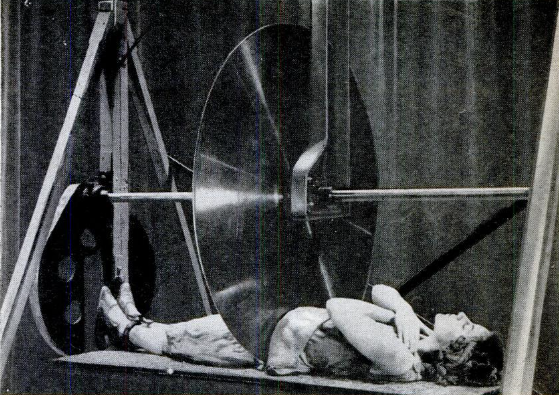
When P.T. Selbit first performed “Sawing Through a Woman” in 1921 at London’s Finsbury Park Empire, he created something revolutionary. The illusion combined:
- Visual horror (a woman visibly divided by a saw)
- Apparent danger (what if something goes wrong?)
- Ultimate safety (she emerges unharmed)
He gave the audience the emotional experience of seeing something dangerous, without anyone being in real peril. It was a masterpiece of dangerous entertainment designed for the modern stage.
Houdini
Harry Houdini took this concept of dangerous entertainment even further. His escapes from handcuffs, straitjackets, water tanks, and buried coffins all carried the implicit question: “What if he doesn’t make it?”
Of course, Houdini was a master showman who meticulously planned every escape. But he understood the power of perceived danger. He let audiences believe they might witness his death. The longer the escape took, the more the tension built. Were those struggles real? Was he actually in trouble this time?
This is rope dancing perfected—all the psychological impact of mortal danger, with (mostly) controlled risk.
I say “mostly” because Houdini did actually injure himself multiple times, and many believe his death at age 52 was directly related to a stunt injury, where he allowed people to punch him in the stomach. Once, whenready read,y it led to a ruptured appendix and peritonitis. Even in the age of illusion, danger sometimes breaks through.
Modern Magic: The Illusion of Danger
Today’s most successful magic acts still rely on this dangerous entertainment formula:
David Blaine – Buried alive, frozen in ice, standing on a pole for 35 hours. Real endurance, real discomfort, perceived mortal danger.
Derren Brown – Playing Russian Roulette on National TV.
The Pendragons – Jonathan Pendragon balanced his wife on the point of a sword, and she then appeared to be impaled by it.
Penn & Teller – Often deliberately show the audience the “dangerous” elements of their tricks—the real bullets, the real blades—before performing seemingly impossible feats
There were even two American television specials entitled The World’s Most Dangerous Magic[14]
Conclusion: The Eternal Tightrope
We may no longer stand in the mud of Smithfield, dodging livestock and pickpockets to glimpse a man on a rope, but our pulse still quickens for the similar reasons – the “painful pleasure” remains our most honest human reaction.
We watch these spectacles because they remind us that the line between safety and disaster is thin—a single strand of thread. It’s judged second in a water tank, or a saw blade inches from the skin. In a world that often feels dangerously out of control, watching a performer navigate that risk and emerge unscathed provides a unique kind of catharsis. It is a celebration of survival.
As long as there is a story to tell and a risk to be taken, we will always be drawn to the dark allure of dangerous entertainment. We will always crane our necks, hold our breath, and wait for the moment when the impossible becomes real.
Bibliography
- [1] James Ralph, The Touch-Stone: Or, Historical, Critical, Political, Philosophical, and Theological Essays on the Reigning Diversions of the Town. (London, 1729), 109
- [2] Philip H. Highfill, Kalman A. Burnim, and Edward A. Langhans, A Biographical Dictionary of Actors, Actresses, Musicians, Dancers, Managers & Other Stage Personnel in London, 1660 – 1800. Vol. 13: Roach to H. Siddons (Carbondale, Ill.: Southern Illinois Univ. Press, 1991), 216.
- [3] Portraits of Granger’, St. James’s Chronicle or the British Evening Post, 22 March 1792, 1.
- [4] Anthony Hamilton, Memoirs of Count Grammont, by Count A. Hamilton; A New Translation, with Notes and Illustrations, Embellished with Seventy-Six Portraits, of the Principal Characters Mentioned in the Work (London: Harding, 1792), 108, xxxii.
- [5] https://metro.co.uk/2026/01/29/hey-presto-magicians-sexy-now-spell-26548280/
- [6] Simon Usborne, ‘“People Want to Feel They Might See an Accident” – How Dangerous Is the Circus?’, The Guardian, 26 March 2018, accessed 27 April 2018
- [7] Roger Lonsdale, The New Oxford Book of Eighteenth-Century Verse (Oxford: Oxford University Press, 2009). 282.
- [8] Richard Barton, Farrago: Or, Miscellanies in Verse and Prose. (London, 1739), 50.
- [9] A Humphreys, ‘The Allure of Risk: Are Humans Hard-Wired to Be Drawn to Death-Defying Stunts?’ National Post, 9 June 2012, accessed 16 August 2018 https://nationalpost.com/news/canada/the-allure-ofrisk-are-humans-hard-wired-thrill-seeker.
- [10] A Humphreys, ‘The Allure of Risk: Are Humans Hard-Wired to Be Drawn to Death-Defying Stunts?’ National Post, 9 June 2012, accessed 16 August 2018 https://nationalpost.com/news/canada/the-allure-ofrisk-are-humans-hard-wired-thrill-seeker.
- [11] Eric G Wilson, Everyone Loves a Good Train Wreck: Why We Can’t Look Away (New York: Farrar, Straus and Giroux, 2013), 27-28
- [12] Joseph Strutt, The Sports and Pastimes of the People of England: From the Earliest Period, Including the Rural and Domestic Recreations, May Games, Mummeries, Pageants, Processions and Pompous Spectacles (Methuen & Company, 1801). 180
- [13] News’, London Evening Post, 5 February 1740
- [14] https://en.wikipedia.org/wiki/The_World%27s_Most_Dangerous_Magic
Now, do you want to see some magic? Well, you can visit my relevant pages (weddings, corporate, parties) or book me to perform at your events. I ctightrope-rope walk, though I’m afraid!
Away from the stage, Adrian holds a Master's degree in Early Modern History from the University of York and occasionally volunteers at York Castle Museum in Victorian costume. When he's not performing magic, you'll usually find him building models, reading, gaming, or exploring his passion for history.
- Autumn Wedding Fairs – Come and Experience Close-Up Magic Live - 14/09/2026
- The Truth Behind Psychic Mediums: A Magician’s Perspective - 28/08/2026
- Grand Villa Heights – Coastal Wedding Magic - 09/07/2026