
Almost Alive: The Strange History of Waxworks
Have you ever been to Madame Tussauds, or visited another waxwork exhibition? Amazing or creepy? Perhaps a bit of both. The history of waxworks is full of that uncomfortable mixture: admiration for the craftsmanship and a slight wish that the figure would stop looking at you.
There’s something slightly uncomfortable about standing beside a really convincing wax figure.
You know it isn’t a person. That part isn’t in doubt. Yet you still find yourself examining its face, watching its eyes and wondering whether it might move. Just in case, right? If it did, you’d probably leave rather quickly!
Waxworks play with that strange overlap between the living and the artificial. They look like people, but something is missing. Or perhaps there’s just enough there to make their stillness feel wrong.
For visitors to London’s exhibitions in the seventeenth and eighteenth centuries, that mixture of curiosity and unease was part of the attraction. Wax figures offered a chance to encounter famous faces, examine artificial bodies and see things that appeared almost alive.
Convincingly human. Slightly unsettling.
Of course, not every waxwork manages a convincing likeness. I remember reading about the infamous exhibition in Great Yarmouth. I mean, wow. Have a look at The World’s Worst Wax Museum to see what I mean. I daren’t post the images here!
But when the likeness works, why can it feel so unsettling?
Writer Marina Warner explores the strange appeal of wax figures in her essay Waxworks and Wonderlands.[1] Wax can imitate the appearance of skin, helping an artificial face look convincingly human.
That resemblance creates an uncomfortable possibility. The figure might look like someone who could move at any moment, but its absolute stillness can also suggest a dead body. The material that makes it convincing can make it disturbing too.
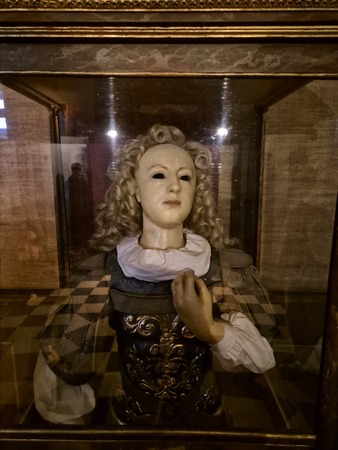
Wax figures had a historical connection with death through funeral effigies: representations of people made for display or commemoration. Historian Richard D. Altick connects this tradition with the morbid associations of waxwork exhibitions.[2]
Visitors could admire the craftsmanship while feeling slightly uneasy about the result.
Famous faces and dreadful stories
Like their modern counterparts, historical waxworks gave visitors the opportunity to see representations of people they recognised.
Mrs Salmon’s Fleet Street exhibition included conntemporary actors shown in theatrical roles. A guide published in 1800 listed John Philip Kemble as Octavian and Sarah Siddons as Jane Shore.[3]
A chain or pretending there with waxworks – An artificial person representing a real person playing somebody else. I suppose it’s the next best thing to meeting them in reallife! But famous faces were only part of the attraction…
An advertisement from 1785 included Princess Andromeda about to be devoured by a sea monster, a representation of the extraordinary claim that the Countess of Hennenberg had given birth to 365 children![4]
There was quite a lot going on.
These were advertised stories and attractions, rather than reliable evidence that the events had happened. But they show the mixture of subjects exhibitors thought would draw a crowd. Royalty, remarkable births, gruesome deaths and a sea monster. Plenty to discuss on the way home.
Looking beneath the skin
Some waxworks went considerably further than getting someone’s face right.
Anatomical models recreated the inside of the human body, revealing structures normally hidden beneath the skin. Visitors could examine artificial organs, muscles and the workings of pregnancy. Educational, certainly, but perhaps not everyone’s first choice for an afternoon out.
These displays appeared in London by 1719, when the nephew of French surgeon Desnoues arranged temporary exhibitions.[5] Desnoues later brought models to London himself, displaying them at a surgeon’s house beside a chemist on Pall Mall. Admission cost five shillings, putting the experience beyond the reach of many poorer Londoners.[6]
Later, after his death, a display in a grocer’s shop charged one shilling and nine pence. Visitors could also buy a syllabus explaining the human body.[7] By 1745, an advertisement offered admission for a shilling.[8]
The falling prices raise an interesting question. Had wealthier visitors already seen enough, leaving exhibitors looking for a wider audience? Or had the novelty started to wear off? The advertisements show the changing prices, but they don’t tell us exactly why.
Either way, a visit to the grocer’s could involve considerably more anatomy than you expected.
A body that reveals its own secrets
What makes anatomical models particularly unsettling is the combination of a recognisable person and an exposed interior.
Some models were posed as though they were alive, even appearing to hold back their own skin to reveal what lay underneath. Related anatomical sculptures included female busts with open abdomens also known as the rather romantic(!) “the anatomical Venus”, such as those made in terracotta by Giovan-Battista Manfredini in the 1770s.[9]
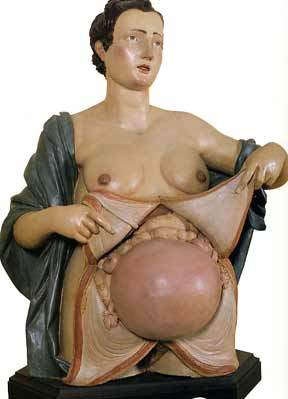
That detail matters: these artificial bodies weren’t always wax. Nor were they simply collections of organs laid out for inspection. They could retain a face, a pose and something resembling a human presence.
You might be looking at a calm expression above an opened body.
There’s a tension between the model’s purpose and its appearance. It explains anatomy, yet it can also resemble someone to whom something rather dreadful has happened.
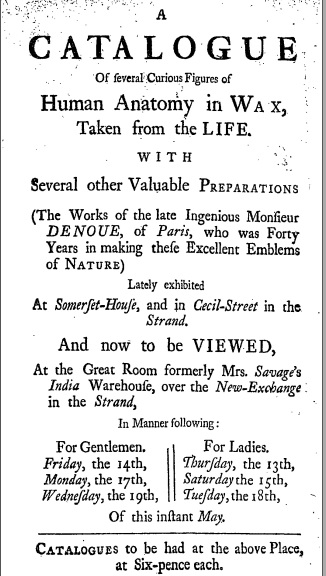
A London catalogue from 1736 advertised anatomical wax figures taken from life. Its contents included a model showing a woman at the end of pregnancy, with intimate anatomical details exposed for examination.[10]
The promise of accuracy was part of the attraction. These were artificial bodies, but exhibitors wanted visitors to appreciate how closely they resembled real ones.
Who was doing the looking?
There’s another question here: whose bodies were being displayed, and who was looking at them?
The anatomical catalogues discussed here included numerous models of women and children, with female figures exposing reproductive organs or showing stages of pregnancy.[10] Those subjects had an obvious educational purpose. But the way a body was posed and presented could also shape how visitors responded to it.
Some anatomical figures combined an exposed interior with a graceful pose or an attractive face. The Manfredini bust is one example of how anatomical detail could sit alongside a carefully composed female figure.[9]
This is where the idea of the male gaze becomes useful. Put simply, it asks how women are represented when their appearance is arranged for the pleasure or judgement of a presumed male viewer.
Applied here, it encourages us to ask whether visitors were being invited to understand a body, admire it, or perhaps do both.
That doesn’t mean every man attending an anatomical exhibition was there for sexual interest. Nor does it mean women were absent. Exhibitions advertised separate visiting days for men and women.[10][11]
But education wasn’t necessarily the only possible attraction of an exposed body.
Not everyone welcomed these displays. In Elizabeth Cooper’s 1735 play The Rival Widows, Lady Lurcher objects to people viewing anatomical waxworks in broad daylight.[12] This is a character speaking in a play, so it doesn’t establish what everyone thought. It does suggest that the subject could be used to provoke a reaction.
For visitors, the experience could combine learning, curiosity and discomfort. Those responses don’t necessarily cancel one another out.
Almost a person
Other accounts show how easily descriptions of artificial figures could slip into the language used about living people.
In The London Spy, Ned Ward described wax figures as “soft and Languishing”. He also told a story about a country visitor who supposedly mistook the figures for living people and tried speaking to one.[13]
It’s an entertaining image: someone attempting a polite conversation with a waxwork while everyone else enjoys the misunderstanding.
But Ward was a satirical writer, and the joke comes at the country visitor’s expense. We shouldn’t treat it as proof that audiences routinely believed wax figures were alive.
What it does reveal is how useful that uncertainty was as a story. An artificial figure could be described as attractive, mistaken for a person, and made the centre of a joke about somebody else’s supposed ignorance.
The waxwork stayed silent. The people looking at it supplied the attraction, embarrassment and laughter.
When standing still wasn’t enough
Adding movement created another opportunity to blur the distinction between an object and an apparently living body.
Mechanical figures, known as automata, used mechanisms to imitate actions associated with life. A handbill advertising a London waxwork exhibition in 1664 described a figure moving its eyes and lifting its hands.[14]
Those are small actions, but we associate them with awareness and intention. A raised hand can look like a gesture. Moving eyes can suggest that someone is looking.
After you’ve reassured yourself that something is only a model, seeing its eyes move could undo quite a lot of that reassurance.
The surviving descriptions need some care, though. The same handbill described figures as being in a “moving posture”.[14] That could suggest actual movement, but it might also describe a pose that looked active.
An advertisement tells us what an exhibitor promised. It doesn’t independently prove what every figure could do.
Showmen wanted to attract customers. Their descriptions weren’t instruction manuals.
Mother Shipton’s parting gift
One mechanical figure seems to have taken a rather direct approach to audience interaction.
According to an account discussed by Altick, Mrs Salmon’s waxworks included a figure of Mother Shipton, the Yorkshire prophetess. As visitors left, they stepped on a concealed mechanism in the floor, causing her leg to kick out at them.[15]
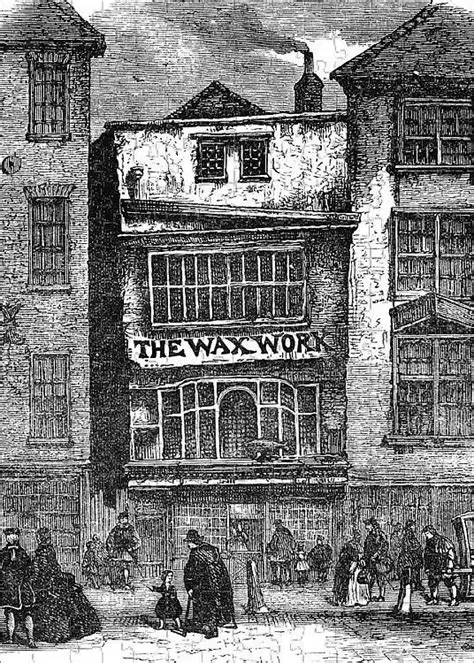
Quite a way to thank someone for coming which I imagine some visitors appreciated it more quickly than others.
Where magic comes into it
As a magician, I find this relationship between knowledge and feeling particularly interesting.
You can know that a wax figure is artificial and still feel uneasy beside it. You can understand that a mechanical movement has an explanation and still jump when it happens.
Watching magic can involve a similar experience.
You know you’re watching a performance. You expect skill, methods and carefully arranged surprises. Yet when something impossible appears to happen in front of you, that knowledge doesn’t necessarily stop the reaction.
For a moment, what you’ve seen is difficult to fit with what you know.
The explanation and the feeling don’t always arrive together.
Details matter too. With a waxwork, a familiar expression or a small movement can help suggest life. In a magic performance, a glance, a pause or an apparently ordinary action can help make a moment convincing.
And, as Mother Shipton demonstrates, timing can make an enormous difference.
Sources
[1] Marina Warner, “Waxworks and Wonderlands”, in Visual Display: Culture Beyond Appearances, edited by Lynne Cooke and Peter Wollen (Bay Press, 1995), p. 189.
[2] Richard D. Altick, The Shows of London (Harvard University Press, 1978), p. 51.
[3] Anonymous, A Companion to All the Principal Places of Curiosity and Entertainment in and about London and Westminster, 9th edition (London, 1800), p. 96.
[4] Anonymous, Mrs. Salmon’s Royal Wax-Work, in Fleet Street (1785).
[5] Andrew Cunningham, The Anatomist Anatomis’d: An Experimental Discipline in Enlightenment Europe (Routledge, 2016), p. 247.
[6] Altick, The Shows of London, p. 54.
[7] George Thomson, Syllabus. Pointing out Every Part of the Human System (London, 1739), p. 1.
[8] “Advertisements and Notices”, Daily Advertiser, 28 June 1745, issue 4509.
[9] Martin Kemp and Marina Wallace, Spectacular Bodies: The Art and Science of the Human Body from Leonardo to Now (University of California Press, 2000), p. 67.
[10] Anonymous, A Catalogue of Several Curious Figures of Human Anatomy in Wax, Taken from the Life. With Several Other Valuable Preparations (London, 1736), title page and p. 11.
[11] “Advertisements and Notices”, London Daily Post and General Advertiser, 28 July 1736.
[12] Elizabeth Cooper, The Rival Widows, or Fair Libertine (1735), edited by Tiffany Potter (University of Toronto Press, 2013), p. 57.
[13] Ned Ward, The London Spy Compleat (1703), pp. 251–252.
[14] Anonymous, Extraordinary, and Unparallel’d Curiosities, Composed of Wax, (so near the Life, That They Cannot Be Excelled by Art) in Seven Several Scenes (London, 1664).
[15] Altick, The Shows of London, p. 52.
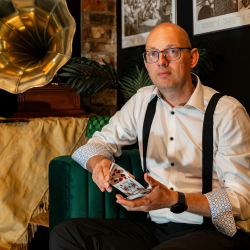
Away from the stage, Adrian holds a Master's degree in Early Modern History from the University of York and occasionally volunteers at York Castle Museum in Victorian costume. When he's not performing magic, you'll usually find him building models, reading, gaming, or exploring his passion for history.