
Misdirection: Magician’s Greatest Trick – What is it?
Last Updated:
Post Created:
Introduction
Have you ever watched a magician and been left utterly bewildered? You saw their hands move, objects vanish, and doves appear seemingly out of thin air. But how? As a professional magician for over 10 years, I create those moments of wonder every day. But beyond the disappearing doves and levitating tables, the answer, more often than not, lies in a fascinating skill called misdirection.
What is misdirection, though? The dictionary gives its definition of “the action of sending something to the wrong place or aiming something in the wrong direction” or “the action of making people pay attention to the wrong thing, usually intentionally, so that they will not notice something else.”
But what exactly is it?
It is one of the most important tools in a magician’s arsenal, but it isn’t something magicians invented. The principles behind it are deeply ingrained in human psychology and everyday life, and we all encounter them.
At its core, this is the art of directing someone’s attention away from what is genuinely happening, often by focusing their gaze, thoughts, or perceptions elsewhere. By manipulating where our attention is directed, magicians create illusions that seem to defy the laws of nature.
Magician Jean Hugard even claimed that “misdirection is magic and magic is misdirection” (Hugard, 1960)1.
Picture a magician holding a coin in one hand. They take the coin with the other hand, and, rubbing their fingers, the coin vanishes into thin air. Here’s a quick example of the technique in action!
The Science Behind Misdirection
Misdirection is a field psychologists have studied, as its principles can be applied to many other aspects of our daily lives. The recent interest in misdirection among scientists is primarily due to “insights into some of the limitations of human cognition.”
By exploring this topic, they aim to uncover the reasons behind our tendency to be deceived and the role of our cognitive processes in it. Research shows that external cues and distractions easily influence our attention. Another key aspect of misdirection is perception. Our brains often rely on incomplete information and fill in gaps with assumptions and expectations. We have inherent vulnerabilities that make us prone to deception. By recognising our weaknesses, we can better protect ourselves against manipulation in various areas of life.
Types of Misdirection
We employ several techniques in the art of misdirection.
Visual – People naturally follow a person’s gaze. A magician can direct people to look where he wants by looking at that place himself. The use of bright colours will also help distract the audience and divert their gaze. People are drawn to a larger movement than a smaller one, so magicians will perform two simultaneous actions, with the larger covering the smaller.
Verbal/Sound – Asking a question usually makes someone turn toward you and make eye contact. A perfect time for a magician, then, to do whatever they need to with their hands! On stage, a loud explosion offstage will, of course, make everyone look over to see what has happened, meaning anything could happen on the other side.
Temporal –Timing is another powerful tool. By controlling the pace of a performance — perhaps leaving a pause between two moments or suddenly speeding things up — a performer can influence what spectators remember and where their attention is focused.
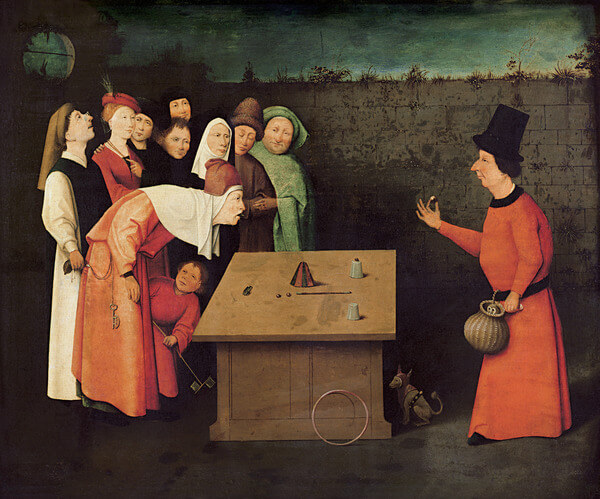
Misdirection in Your Everyday Life & Business
So, can these principles be useful outside of magic? Absolutely.
In business, we can improve presentations, especially when trying to grab our audience’s attention. People follow the eyes, so eye contact is important. Sweeping your eyes over the whole crowd, not just the front row, gives everyone some attention, so they will concentrate more on you while speaking and feel more involved. Additionally, using your hands to point naturally draws people’s attention to the area you are pointing to, allowing you to emphasise your points more clearly.
You can use it to focus people’s attention on a single aspect of a message or to highlight features while glossing over the negatives. Using timing to speed up parts of your speech and slow down others can influence how clients perceive you. A strategic topic, tangential to what you are talking about, can divert attention during a complicated conversation.
This article only scratches the surface of the subject! If you’d like to explore the psychology behind attention and deception in more depth, I’ve included some useful resources below. Check out the links below to explore the psychology behind misdirection and how it’s used in everyday life. If you want to see my magical skills, book me for your next corporate event!
Hugard, J. (1960). Misdirection. Hugard’s Magic Monthly, March, 115.
Science & Technology Studies 35(2) – Kuhn et al. 112182-Article Text-235683-1-10-20220513.pdf (gold.ac.uk)
Frontiers | Misdirection – Past, Present, and the Future (frontiersin.org)
The Science of Misdirection | Psychology Today United Kingdom
Misdirection: A Magician’s Guide to Spotting and Avoiding Manipulation in Your Life
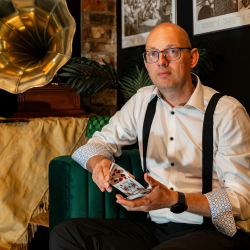
Away from the stage, Adrian holds a Master's degree in Early Modern History from the University of York and occasionally volunteers at York Castle Museum in Victorian costume. When he's not performing magic, you'll usually find him building models, reading, gaming, or exploring his passion for history.
- Autumn Wedding Fairs – Come and Experience Close-Up Magic Live - 14/09/2026
- The Truth Behind Psychic Mediums: A Magician’s Perspective - 28/08/2026
- Grand Villa Heights – Coastal Wedding Magic - 09/07/2026